Memories are a unique and special kind of source of information. They are extremely important in remembering events of the past but are also often doubted as they are not entirely trustworthy. Footage acquired from documentaries are shown to try and prove that the story or information being presented is truth. Images can easily be malleable and manipulated to fit the source of proof required through the editing process of filmmaking. In the documentary films “Waltz with Bashir” and “Stories We Tell” similar concepts are presented, such as manipulation, doubt, and reality vs textuality.
The Importance of Documentary Films
Many important concepts were explored through film, art and truth in this section of the course, the main ones being the reality vs textuality paradox, the critical concept, the emotional concept and lastly memories. The reality vs textuality paradox is the combination of real footage and the editing process by humans. Filmmakers take real stories and experiences but film them in a certain light or camera angle. Reality vs textuality is linked to knowledge because in informative documentary films, the facts and the presumed truths are already known, and the films simply serve to teach and reiterate them to the viewers in an entertaining way. With advanced technology, it is very easy to manipulate photos or simply omit information on camera, and as a result there is often a sense of doubt and questioning present when viewing documentaries.
The critical concept in documentary films is very important, as filmmakers want their viewers to doubt certain elements of their work, to have them lingering with questions or concerns. A fair amount of doubt in the viewers is the goal. Leaving the audience with questions influences viewers to speak about and discuss their opinions and thoughts. Documentaries are made to either look back on the past and learn about certain historical events, or to hear someone’s personal story that will end with a message. By looking at educational documentaries, there will be a lot of footage shown as their proof or truth of the situation. In other documentaries there will be interviews to try and persuade the audience. Since these documentaries are apart of the reality vs textuality paradox, critical thinking and questioning is bound to follow. Not only do documentary films make the audience question their facts and presented truth, but they can also make the audience emotional.
As previously mentioned, documentary films often have an emotional impact. They can make their audience laugh, cry, and feel anger or frustration. Documentaries are meant to communicate with the audience, as the audience watches the films from a safe distance and therefore can only be affected through their emotional responses. Filmmakers will choose specific people to interview and will ask specific questions to each person, often worded in a way to get the answers they want and to create an emotional connection. In documentary films that discuss someone's life story, their experiences can very likely be passionate, sensitive, and very touching. The emotional connection felt by viewers can make them feel empathetic or angry towards them. Emotions are very strong feelings that have a lasting effect. When something or someone has made such an impact on one’s emotions, it doesn’t go away very quickly, they therefore can become part of one’s memories.
Memories are very delicate. They can be manipulated, or selective, and they are often an unreliable source of information. Emotions play a significant role in memories, whether or not someone remembers certain details or remember them in a specific way. It is very simple to manipulate someone’s memories, to tell them that an event had occurred when they were younger through proof of a photoshopped picture of them. Memories are dangerous to rely on as a source of objective truth. There will always be doubt about the past and due to such inevitability also comes the suppression of certain traumatic events. Therefore, in film, art, and truth, it is crucial that filmmakers use the reality vs textuality paradox, as well as critical and emotional concepts to get in touch with the audience, leaving them with questions, doubts, emotions, all while leaving a lasting impact on their memories.
The analysis of Waltz with Bashir
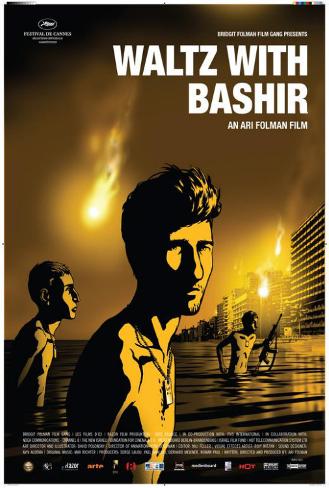
The human brain is a powerful thing. It has the ability to create memories, but can also create false memories, distorting our reality and impairing our judgement. In the movie Waltz With Bashir (2008 Israeli animated documentary film written and directed by Ari Folman), we can see the topic of memory being explored. The opening sequence of the film featuring a dream in which dogs torment a city is later revealed to occur as a result of Ari's memory of his past. Ari's memory of being forced to shoot dogs during his time in the war had warped into a recurring nightmare. War has manipulated his memories out of fear and regret. The film explores the concepts that surround memory in a deeper way.
Ari Folman, the protagonist, is having trouble remembering what he did in the war. Wanting to try and remember, he travels to speak to some of his war brothers as well as psychologists. Each person he interviews gives him pieces to his puzzle, revealing their own memories, but Ari still can never uncover the full truth. It is impossible to rely on memories as a sole source of objective truth. Ari visits a psychologist, who tells him the story about the boy and his day at the Carnival. The boy was shown ten pictures of himself in different places he’s been to, but one of them was photo-shopped. It showed the boy standing in the middle of the carnival, he asked to boy if he remembered that day. The boy went on saying that it was a great day; he said he had so much fun with his parents. That day never happened. The boy's memory made him think it did, his head manipulated him into believing something that never happened. This brings a lot of doubt in images and makes them hard to trust.
One of Ari’s friends tells him about the time he murdered a child with an RPG in his hands. He had no memory of what happened, as he had blocked out the traumatic event. Many people suffer from posttraumatic stress disorder, and it is extremely common in soldiers. Ari’s memory plays tricks on him, when he tries to remember the massacre in particular. He remembers coming out of the ocean and going to the streets. One of his friends told him that this never happened.
This documentary is quite unique; given that most of the movie is animated until the very end. By using animation there are all sorts of advantages. Ari, the director and protagonist, was able to show how the war affected him through his own eyes. Animation also has disadvantages. It’s hard for viewers to see these images as reality. It makes it harder for us to connect; Ari went to great lengths to put as much detail as he could. To make sure his viewers got the point across, he placed actual footage at the end of his film. The point being it actually happened, and that it is reality and not fiction. He wants to exploit our emotions for us to feel what he feels, and see what he sees. Although memories are shown to not be trustworthy, this film does a great job of showing how the experiences of each person interviewed differ, and can help to construct a clear picture. This also relates back to the techniques used by documentary filmmakers when trying to prove a certain point. In choosing to show a limited view of a topic, filmmakers can omit a great amount of truth and information, distorting what the viewer considers to be real.
The Thematic significance of Stories we Tell
Stories we Tell (2012, 1h58m) is a Canadian documentary film created by Sarah Polley. The film centres around Sarah’s deceased mother, Diane Polley, and features interviews with family members, lovers, and close friends detailing her fascinating life. In the beginning of the film, all interviewees have overwhelmingly positive stories to share about Diane, speaking about her brilliant acting career, her love for her children, and her general positive character. However, as Sarah dives deeper into the life of her mother and asks more interrogative questions in her interviews, she discovers many dark secrets about her mother’s past. Interviewees are reminded of hidden memories about Diane that they rarely revisited, including the story of her having an affair and being impregnated by her lover. Together, the testimonies of everyone interviewed helps to construct a more complete image of her life, with each interviewee contributing their own “image” of Diane. While her family members and friends maintain a very positive image of Diane throughout the film, it is evident that they each hold less appealing memories of her that they choose to think about less.
The general flow of this film illustrates a very clear manipulation of the image of Diane Polley that is trying to be presented. Early in the film, there are many fake scenes of old film featuring Diane smiling, laughing and dancing, accompanied by positive stories of her life, which give the viewer a positive, albeit skewed, perspective on Diane. As the film continues, there is a shift from a more general approach to her life, to a more detailed and deep testimony from those interviewed. As darker and more emotional scenes are presented, the viewer’s image of Diane changes, illustrating how the objective truth about our opinions is highly dependant on what the filmmaker chooses to expose us to. This relates to the aspect of hidden and censored memories. The family members interviewed were immediately reminded of positive stories, but slowly began to have more negative memories of their childhood as the interviewer pressed on with deeper questions. For example, Diane’s son Mark begins to remember moments of being abused by his stepmother after their parents’ divorce, and how being away from Diane made the children extremely sad.
Each interviewer has a different perspective on Diane based off their personal experience with her. By combining the testimony of everyone related to Diane, Sarah Polley was able to construct a clear image of Diane’s life. As more and more information and memories are brought up, everyone’s (including the viewer’s) interpretation of Diane is altered. This serves to show that no matter how much information is presented on a topic, an objectively true description of Diane’s life is impossible to construct and put into film. As it is revealed that the scenes featuring Diane are in fact fake and were created specifically for the film, it becomes evident that Sarah Polley used certain techniques in order to portray a specific image of Diane. “Stories we Tell” as a whole demonstrates that omission can help documentary filmmakers portray the image of a certain person or concept in any way they please. The development of the film and the way in which polarizing memories of Diane are brought up illustrate the concept of how what we know as “truth” can be altered and changed very easily.
A Personal Opinion
This week’s subject revolved around memory and how it cannot always be reliable. Although quite amazing, our minds may not be as perfect as we think. Like in the case of Ari Folman in the film “Waltz with Bashir” he was a young man who fought for Palestine in the war against Lebanon (1982-1985) and in the current day, can’t seem to remember specific events that occurred during his time served.
As a group, we have collectively watched many movies of various genres but had never seen an animated documentary. “Waltz with Bashir” tries to pass on a message to us, the audience, in a different way. The director, Ari Folman, wanted us to figure out what his message and goal was indirectly by having the main character himself, have conversations with different people, as well as have flashbacks to the events that occurred in the Lebanon War. Our group had mixed opinions about the film. While the style was very unique, we found the animations to sometimes distract us from the points Folman was trying to put forward. Our interpretation of the film was left open-ended due to the lack of background information on the history of the events being described. However, a positive from the film was that Ari decided to add real footage of at the end of the documentary to the “Sabra and Shatila massacre” where women were crying and running away from gunfire. This scene was successful in showing that although the film was animated and people may think it’s fictitious, the events were real and truly horrifying.
Ari plays with our emotions by having a scary animated beginning with the dogs running in the street and barking then cutting to real-time where he goes to see old friends to talk about the war. As the film gets closer to the end, there is animated gunfire followed by real footage of the massacre in order to display the brutality of the events. Ari's inability to remember certain events is understandable, as they were deeply traumatic. According to the U.S. Department of Veterans Affairs, war veterans often suffer from PTSD, and as a result have their memories affected. Veterans are also more likely to suffer from physical and mental disorders such as depression, anxiety, and substance abuse. The amnesia experienced by Folman is very different from simple forgetfulness we may experience in our day to day lives. Waltz With Bashir shows that when experiencing a violent, traumatic episode, the mind can often alter or suppress certain memories. This effect is truly horrifying considering the amount of war and tragedy occurring in our world today, especially in the Middle-East. The memories of entire populations can be affected by traumatic events, leading to a multitude of issues later on in life.
The films viewed and discussed in this section of the course served to illustrate how documentary films are strategically created in order to prove a point. Waltz with Bashir and Stories We Tell were both addressed the imperfection of human memory. Just as documentaries appeal to our emotions in order to be believed, our memories are stored and brought up in accordance with our emotions. The objective truth, as presented in a documentary film, is not to be trusted with absolute certainty, just as our memories are not to be considered perfect and free of error. In short, these films were very successful in illustrating the divide between reality, and what we perceive reality to be through our experiences.
The films viewed and discussed in this section of the course served to illustrate how documentary films are strategically created in order to prove a point. Waltz with Bashir and Stories We Tell were both addressed the imperfection of human memory. Just as documentaries appeal to our emotions in order to be believed, our memories are stored and brought up in accordance with our emotions. The objective truth, as presented in a documentary film, is not to be trusted with absolute certainty, just as our memories are not to be considered perfect and free of error. In short, these films were very successful in illustrating the divide between reality, and what we perceive reality to be through our experiences.

No comments:
Post a Comment